

Eclectic bedroom decor is all about bringing your favorite pieces, colors, patterns, and styles together in a way that feels collected rather than chaotic. The goal isn’t to make everything match. It’s to create a bedroom where different influences work together and still leave the space feeling calm, comfortable, and personal.
I used to think eclectic bedrooms were basically permission to put every beautiful thing in one room. Then I realized that’s how you end up with five different wood finishes, a rug fighting the curtains, and lighting that makes your bedroom feel more like an office.
The best eclectic bedrooms have something in common: they feel lived-in without feeling cluttered. They mix old and new, bold and simple, soft and structured, while still having a clear visual direction.
So instead of treating eclectic decor as a random collection of things you love, think of it as a system. Choose a few strong anchors, add contrasting pieces for personality, and use repeating colors, materials, and shapes to connect everything.
To me, an eclectic style bedroom is simple: it combines different influences while telling one clear story. Once you understand that balance, decorating becomes much easier.
Eclectic Bedroom Decor Ideas
Think of these ideas as easy starting points. You don’t need to use every one. Pick two or three that fit your room and build from there.
Commit to a Grown-Up Anchor Bed
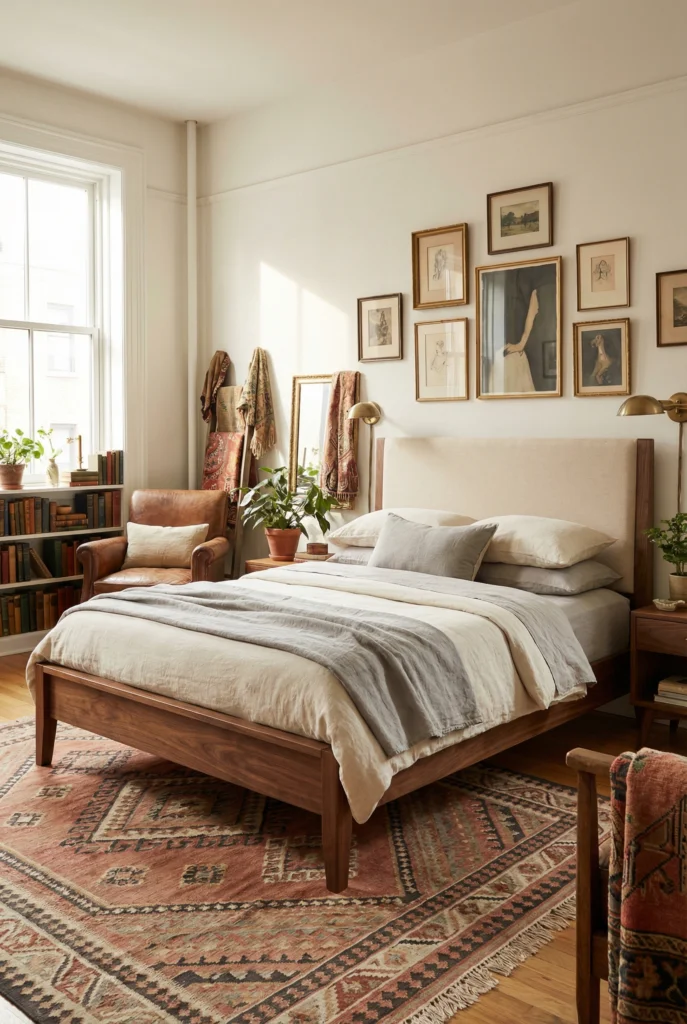
Choose a substantial bed frame or an upholstered headboard with clean, confident lines. A strong bed gives the room a visual anchor, allowing more unusual artwork, vintage finds, and decorative pieces to feel intentional.
Mismatched nightstands that still relate
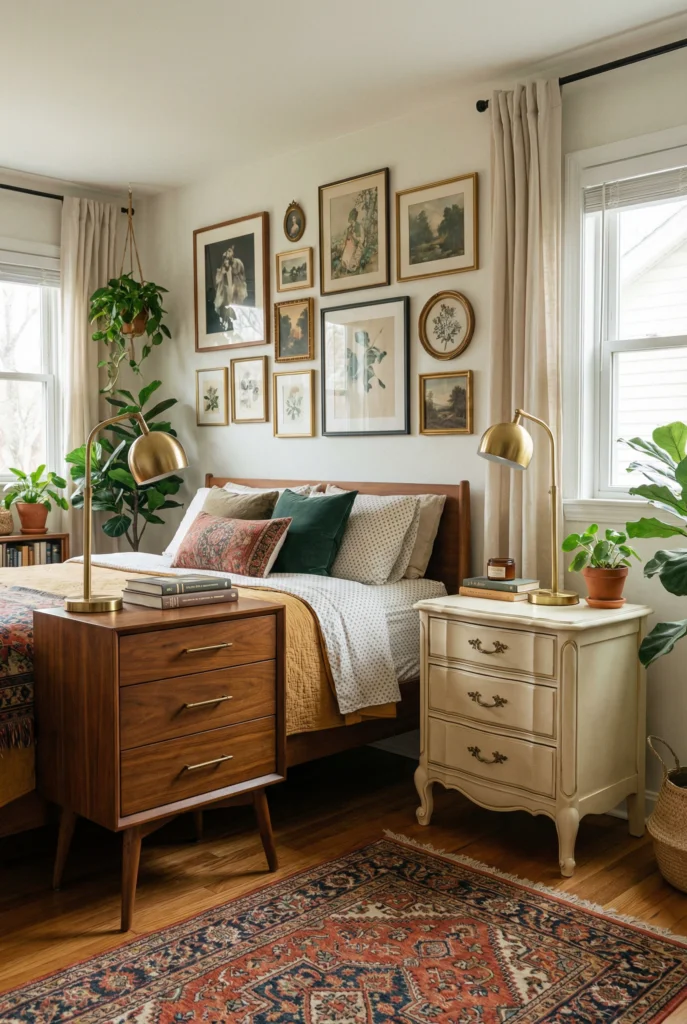
Your bedside tables don’t have to match perfectly. Try a modern nightstand on one side and a vintage stool or wooden table on the other. Connect them with something they share, such as similar wood tones, matching hardware, or identical lamps.
The goal is for them to feel related rather than completely random.
One focused gallery wall

Instead of putting artwork on every available wall, create one intentional gallery wall above the dresser or beside the bed.
Combine photographs, paintings, prints, and smaller decorative pieces, then connect them through a shared frame color, palette, or theme.
A calm feature wall behind the bed

Painting or wallpapering the [wall behind your headboard] creates an easy focal point. A feature wall can make the bed feel more substantial while allowing the remaining walls to stay relatively simple.
This is especially useful if you enjoy bold color or pattern but don’t want the entire bedroom to feel overwhelming.
Bold wallpaper in a smart dose
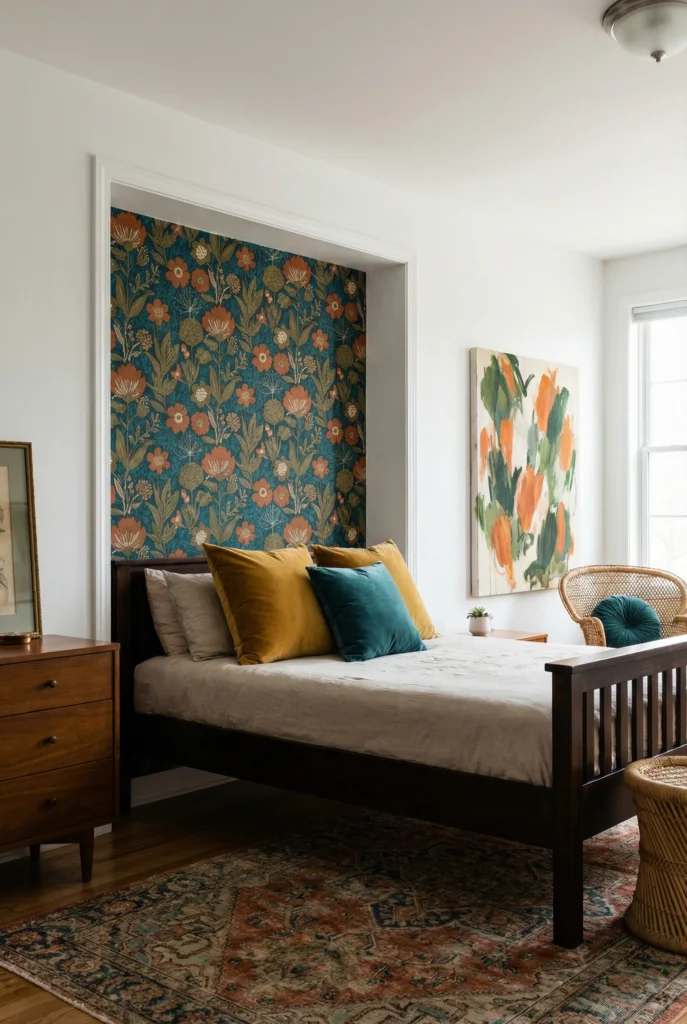
If you love pattern, you don’t have to cover every wall. Try bold wallpaper behind the bed, inside a niche, or on one accent wall.
Pull one or two colors from the wallpaper into your pillows, artwork, or accessories. Those small repetitions make the pattern feel connected to the rest of the room.
Soft-to-nubby texture story on the bed

Start with comfortable soft fabrics such as cotton or linen, then add a few more tactile elements. A boucle pillow, woven blanket, or chunky knit throw can introduce texture without making the bed look overly busy.
Think soft first, texture second.
Patterned curtains as quiet glue

Patterned curtains can work as visual connectors. Choose a design that repeats a color already found in the rug, artwork, or bedding.
Because curtains occupy so much vertical space, they can help distribute color throughout the bedroom and make the overall design feel more balanced.
Scatter cushions as color connectors

Pillows are one of the easiest ways to tie an eclectic room together. If your artwork contains a little rust, repeat that shade in a cushion. If your rug includes muted blue, bring that color into another textile.
These small repetitions can make very different pieces feel like they belong together.
Plush velvet bench at the foot of the bed
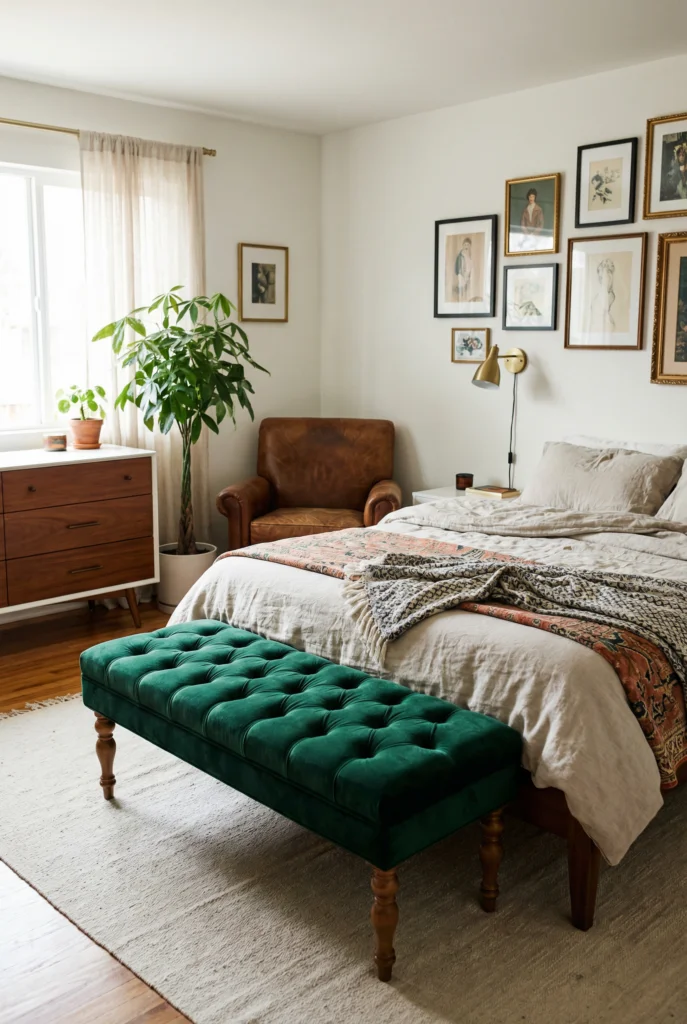
A plush velvet bench at the foot of the bed adds softness, color, and a little luxury. It can also be surprisingly practical for extra seating or temporarily holding clothes.
Choose a color that appears elsewhere in the bedroom so the bench feels like part of the design rather than an isolated statement.
Mix metals, but give each a buddy

There’s no need to use only one metal finish. Brass, black, chrome, and bronze can all work in the same bedroom.
The trick is repetition. If you introduce a particular finish, use it at least twice. A brass lamp paired with brass hardware or a black mirror frame paired with a black curtain rod will feel much more intentional.
Use books as color and height

Books are an easy way to add personality to dressers and nightstands. Stack a few books to create height, then add a candle, vase, or small decorative object on top.
They provide color and character without making the room feel overly decorated.
One oversized mirror instead of lots of small ones

Instead of filling a wall with several small mirrors, consider one large mirror. It can make the bedroom feel more spacious, reflect natural light, and provide a strong visual anchor.
A leaning floor mirror is especially useful in an eclectic bedroom because it feels relaxed rather than overly formal.
One delightfully weird lamp
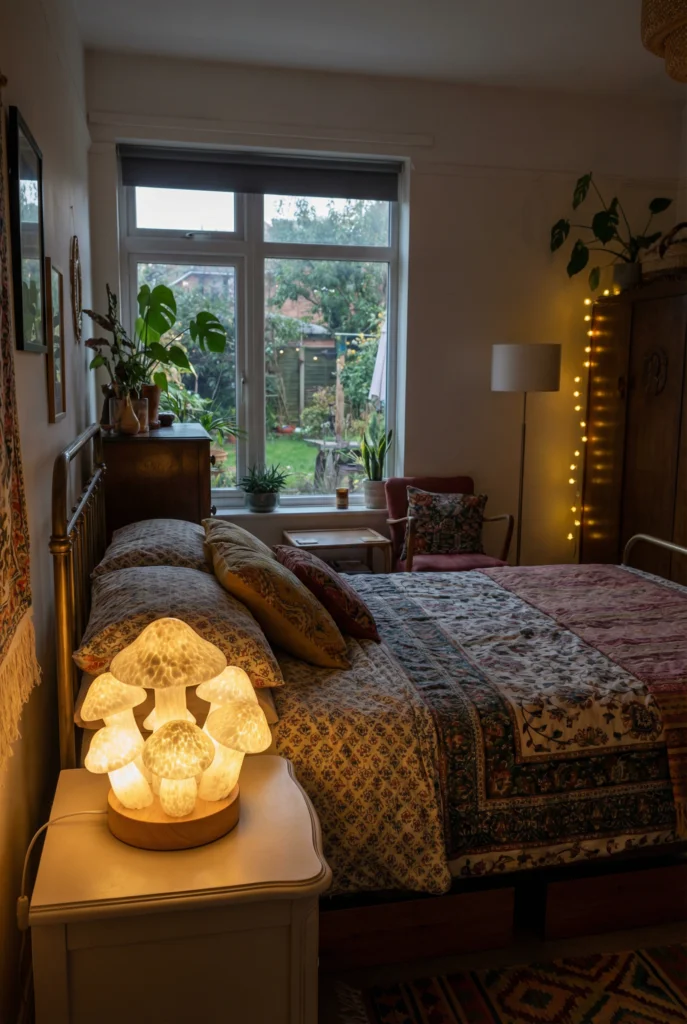
Keep most of your lighting simple, then allow one lamp to have a little personality. A sculptural base, mushroom shape, unusual shade, or playful silhouette can become the unexpected detail that makes the room feel unique.
You only need one or two quirky elements to keep the design interesting.
Upgrade the ceiling light when you can

The overhead light has a bigger impact than you might think. Replacing an outdated fixture with a simple flush mount, pendant, or sculptural ceiling light can instantly make the bedroom feel more finished.
Good lighting also helps eclectic colors and textures look much better in the evening.
Hide the boring stuff in pretty containers

Bedrooms still need to function. Chargers, skincare, books, hand cream, and other everyday items don’t have to remain scattered across your surfaces.
Use lidded baskets, trays, decorative boxes, and small containers to keep practical items accessible without letting them dominate the room.
Mixing Styles and Eras Without Visual Whiplash

Eclectic decorating is about mixing, but successful mixing still needs structure. The easiest way to create that structure is to think in terms of anchors, contrasts, and connectors.
Anchors are the larger pieces that establish the room’s overall direction, such as the bed, dresser, wardrobe, or rug.
Contrasts are the pieces that intentionally look different. A vintage table beside a contemporary bed is a contrast. So is an ornate mirror in an otherwise minimalist bedroom.
Connectors are the details that make those differences work together. Repeated colors, metals, materials, shapes, and finishes can quietly connect pieces that otherwise seem unrelated.
Many eclectic bedroom ideas fail because every item is treated as a statement. Without connectors, the room becomes visually noisy.
What to Do
- Choose one main style or era to dominate roughly 60–70 percent of the room.
- Let your bed and dresser establish that main direction.
- Introduce one to three strong contrasting pieces.
- Repeat materials, colors, or finishes to connect different styles.
- Combine straight lines with rounded shapes for more visual interest.
What to Avoid
- Using many unrelated wood tones without repetition.
- Making every piece a statement.
- Keeping every furniture piece at the same height.
- Covering every wall with unrelated artwork.
- Adding new styles without considering how they connect to what you already own.
Concrete Bedroom Example
Imagine an adult bedroom with a simple linen-upholstered bed and warm oak dresser. These become the anchors.
Add a slim black metal nightstand on one side and a small vintage wooden stool on the other. Use matching brass lamps on both sides.
Then hang a black-framed print above the bed and repeat black through the curtain rod. Suddenly, the vintage and modern pieces feel connected.
The furniture doesn’t match, but the room still feels cohesive because the same finishes appear throughout the space.
A quick trick is to walk around your bedroom and mentally label each major piece as an anchor, contrast, or connector. If something doesn’t seem to have a role, consider moving it, restyling it, or removing it.
Layering Textures and Patterns Like a Grown-up
Textures and patterns can turn an eclectic bedroom into a warm, cozy bedroom, but too many competing elements can quickly become exhausting.
Instead of thinking about adding as many patterns as possible, create a simple pattern hierarchy. Use one large-scale pattern, one medium pattern, and one smaller pattern. Then give those patterns enough solid space around them to breathe.
The same idea works with texture. Start with soft fabrics against your skin and gradually introduce more tactile materials.
What to Do
- Choose one large pattern for the rug or duvet.
- Add a medium pattern through curtains or pillow shams.
- Use a small-scale print on an accent pillow.
- Separate busy patterns with solid fabrics.
- Choose comfortable soft fabrics such as cotton, linen, or bamboo.
- Add tactile finishes through boucle, chunky knits, woven materials, or textured upholstery.
- Repeat an important texture in at least three places.
What to Avoid
- Placing several loud patterns directly beside one another.
- Using only smooth, flat materials.
- Making everything shiny.
- Choosing fabrics based entirely on appearance rather than comfort.
- Adding texture everywhere without leaving calm areas for the eye.
Concrete Bedroom Example
Imagine a welcoming bedroom with a faded patterned rug in soft blue and terracotta. Keep the duvet solid cream, then add medium-scale striped pillow shams and a small geometric lumbar pillow.
For texture, use smooth cotton sheets, a linen quilt at the foot of the bed, and a chunky knit throw casually draped over one corner.
Linen curtains can repeat the texture while subtly picking up the terracotta from the rug.
The result feels layered and comfortable without becoming visually overwhelming.
A quick weekend refresh: remove everything from the bed and rebuild it using one pattern, one strong texture, and one accent color. Then add another pattern only if the room still feels too plain.
Color Logic so the Room Feels Intentional, not “Accidentally Rainbow”

Color can make eclectic bedrooms look beautifully collected or completely chaotic. The difference usually comes down to repetition.
Instead of choosing every color you happen to love, think in terms of three main color families: a dominant color, a supporting color, and a small accent.
Neutrals such as cream, white, wood, charcoal, and black can help balance the palette.
What to Do
- Choose a dominant color for large surfaces such as walls, bedding, or rugs.
- Select a supporting color for artwork and textiles.
- Add one smaller accent color through accessories.
- Repeat each main color several times throughout the room.
- Check your colors in both natural and artificial lighting before committing.
What to Avoid
- Using numerous accent colors only once.
- Choosing wall paint before considering existing furniture.
- Trying to match every object to one exact shade.
- Ignoring warm and cool undertones.
- Adding colors simply because they are trending.
Concrete Bedroom Example
Picture a unique bedroom style with warm white walls and a rug featuring charcoal, rust, and oatmeal.
Make charcoal the dominant color, rust the supporting shade, and soft teal the accent.
Charcoal might appear on the bed frame, nightstand, and lamp. Rust can repeat in the quilt, artwork, and lumbar pillow. Teal can appear in a small vase, cushion detail, and tiny piece of artwork.
The result feels colorful without becoming a rainbow of unrelated shades.
A useful trick is to photograph your bedroom and identify the three colors that stand out most. If you struggle to name them because there are too many competing shades, simplify the palette.
Statement Furniture and Personal Expression without Clutter Overload
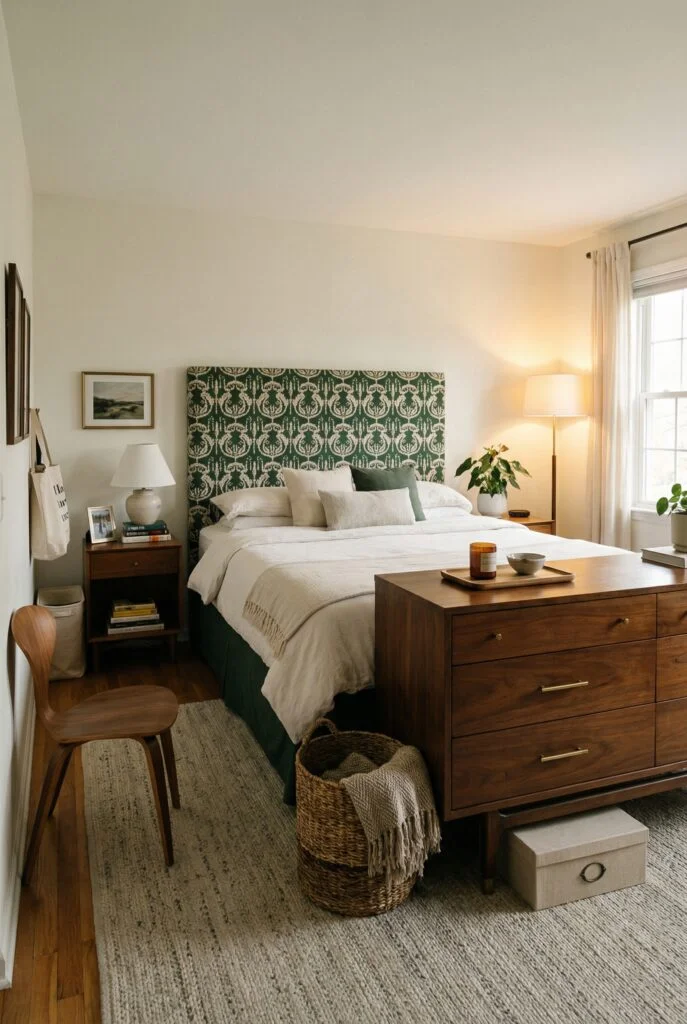
Eclectic decorating should feel personal. Your bedroom should tell people something about you without looking like a storage room for every object you’ve ever collected.
The easiest way to achieve that balance is to choose a few statement pieces and let quieter furniture support them.
Think of your bed, dresser, wardrobe, and perhaps one dramatic chair or bench as the main characters. Smaller objects can add personality without taking over.
What to Do
- Choose one or two hero pieces.
- Keep statement furniture surrounded by visual breathing room.
- Select nightstands that are both attractive and practical.
- Create small styling moments with books, candles, photographs, and meaningful objects.
- Rotate special pieces throughout the year instead of displaying everything at once.
- Keep some areas functional rather than perfectly styled.
What to Avoid
- Covering every surface with sentimental objects.
- Using multiple statement pieces that compete for attention.
- Choosing tiny nightstands that can’t handle everyday essentials.
- Removing all personality because you’re worried about clutter.
- Buying decorative pieces simply to fill empty space.
Concrete Bedroom Example
Imagine an eclectic bedroom decor scheme centered around a vintage wooden wardrobe with carved doors.
Keep the bed simple and low with white sheets and a linen throw. Use clean-lined nightstands with a small bowl, framed photo, and stack of books on top.
At the foot of the bed, add a plush velvet bench in deep blue that connects to a color found in the wardrobe and artwork.
The wardrobe becomes the hero while everything else supports it. That balance allows the bedroom to feel collected, personal, and restful.
A simple rule: choose your hero piece first. If you discover you have three or four heroes, simplify the surroundings of all but one or two.